

A sense of feeling of anticipation. I can see the frosty air coming from my rivals as they do the "about to run" shuffle on the beginning point.
A quick flick of the hips.
I'm at my local Saturday morning race and I mean business. It's almost time...
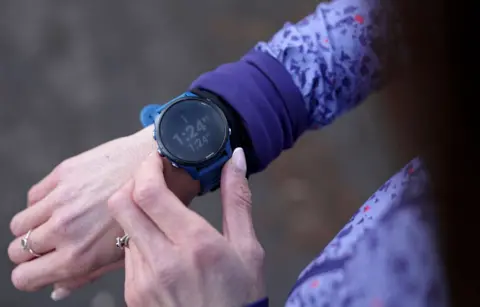
Hold on. I have to adjust my tracker. So does the guy alongside me.
The person waiting sighs. I'm not moving until… there! Signal acquired, away I go.
In the mele, it's hard to see a wrist without a wearable on it. And this extends beyond us participants who wear them.
This is a explosive, massive industry. Names like Garmin dominate, featuring an broad selection of different models to fit a range of budgets. Based on how feature-packed the model you choose, price tags can start from an affordable sum to thousands of pounds.
"It makes me crazy, I can't stop checking."
"It comforts me… It feels like a friend encouraging me."
"I wish it wouldn't say I've had a poor sleep."
Just some of the reactions I've had from other device users when I inquire what they feel about theirs.
The Data Dilemma
My thoughts on mine? Right now, annoying. It's indicating I'm off pace, making me wonder whether the trees I'm passing under are blocking my GPS connection.
Millions of us attach these small monitors onto our wrists and keep them on all day and night, ostensibly at ease with the fact they're constantly tracking us.
A distant memory are the days when we used them solely to give us an estimation of our daily steps. Currently, they can measure our sleep patterns, heart rate, heart rate variability (HRV), our VO2 max.
It's tricky to find a physical metric they fail to monitor.
But can they do what they say they do? And are the statistics we analyse a faithful picture of reality? Do they improve our mental and physical wellbeing, or do the avalanche of measurements and cheerleading alerts just add to our daily stresses?

A Complicated Bond
"I do get a bit preoccupied with mine," one user confesses.
While she appreciates how her device records her workouts, she finds some of its other functions "excessive" at times - a feeling initially realised during a pregnancy.
Before she realised she could put it into a specific mode, her smartwatch repeatedly informed her she was being insufficiently active enough. Later on, the watch keeps telling her she's had a bad night's sleep.
"I've got a six-month old, there's no point to be notified my sleep was poor," she says. "I'm acutely aware perfectly well."
Couldn't she just remove it?
"I could, I suppose, but I'm in this love-hate relationship with it," she continues. "I love it for its workout tracking, I sometimes question whether the myriad other functions it can now do is perhaps overkill for me."
Inside the Device
Every device of smartwatch has its own proprietary way of tracking your vitals and interpreting your data, but the majority use optical sensors on the back of the watch.
They usually project tiny, coloured LED lights onto your arm which can monitor pulsation, detecting your BPM. More advanced devices detect changes in the electrical current that flows through the skin to assess your nervous system activity.
Expert Perspectives
One expert says that overall for smartwatches, it's a "fine balance" - while the continuously improving tech could actually aid early diagnosis, "detecting disease before we feel unwell", it could also turn us device users into the "concerned but fine".
He points out that the most advanced wearables can perform tests like medical-grade monitoring, which constantly monitor how healthy the heart is. They can alert if someone is experiencing a heart arrhythmia, where there is irregular electrical activity in the heart causing an arrhythmia.
This does not automatically signal someone is on the verge of a heart attack, but it can give an preliminary indication they might be more vulnerable of a blood clot in the long term.
But how to understand these readings is not straightforward. The expert concerns that as additional features are added, people may not be able to fully comprehend their data.
"I remain sceptical that having the capacity to monitor so much data is such a positive development," he says.
A health researcher specialising in patient behaviour echoes this sentiment. A study into the effect of wearable tech on a specific group of individuals with health issues suggested a minority of those who were given devices to monitor their heart health experienced increased anxiety and were "more inclined to use healthcare resources".
She observed a vicious circle with her patients - they saw a concerning reading on their watch. They grew concerned. Their pulse rose. They got more worried. They re-examined the data, and their reading rose further.
"If we see stats about ourselves that we can't properly interpret then, understandably, we are going to seek clarification," the psychologist says. "We check, we check again - it becomes a feedback loop."


